Farm Equipment Finance Business Loan Repayment Calculator
Estimate repayments with our Business Loan Calculator. Compare finance options, tailor loan terms, and plan with confidence for your business growth.
'Calculator results are estimates only and not quotes. Actual quotes will be provided by licensed brokers after you submit an enquiry.'
Business Loan Details:
Important!
Business Loan Interest Rates differ from lender to lender and will depend on your individual circumstances (credit history, employment status, age, etc.). To find out if you qualify ... and for a free, personalised interest rate and repayment quote, please CLICK HERE
Business Loan Amortisation Calculator
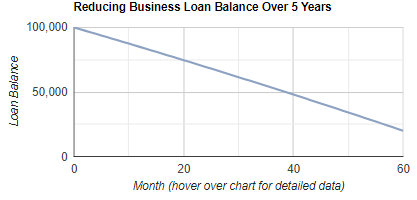
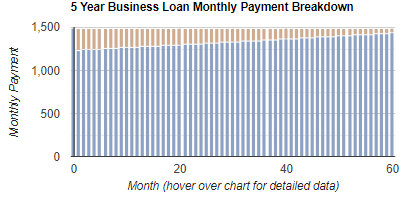
The following amortisation graphs detail month-by-month data on the progress of the proposed loan. The first chart below examines the reducing loan balance over the course of the finance contract term. The second graph illustrates the portion of each monthly repayment allocated to payment of interest vs principal reduction.
How to use our Business Loan Repayment Calculator
Our Business Loan Repayment Calculator helps you estimate business loan repayments, compare finance options and understand the true cost of borrowing before you commit. It is important because small changes to your loan amount, interest rate, term or balloon payment can materially change cash flow, total interest and end-of-term obligations. This calculator provides an indicative estimate only and is designed to support planning and budgeting for business growth.
How to complete each section for the best result:
1. Loan Amount
Enter the amount you expect to borrow as a whole number (no dots or commas). Include any costs you plan to capitalise into the loan, such as stamp duty, registration, insurance or other applicable fees, so the estimate reflects your real financed amount.
2. Balloon or Residual Payment (optional)
Select a residual as a percentage of the purchase price. A higher residual usually reduces ongoing repayments, but increases the amount due at the end and can increase total interest over the term. Choose a residual only if you have a realistic plan to refinance, pay it out, or sell an asset to meet the final amount.
3. Term of Loan
Select the number of years you want to repay the loan. A longer term generally lowers periodic repayments but increases total interest paid. A shorter term can reduce total cost but may place pressure on cash flow.
4. Interest Rate
Select an indicative annual interest rate to run a scenario. Your actual rate depends on lender assessment and your business circumstances, so consider testing multiple rates to stress-test affordability.
How to interpret the results:
1. Repayment estimate
Use the repayment figure as a budgeting guide for regular cash flow planning. If you selected a residual, remember the final payout is additional to the periodic repayments.
2. Amortisation charts
Review the reducing loan balance over time and the split between interest and principal. Early repayments typically include a higher interest component, with principal reduction accelerating later.
General information only, not personal financial advice. It does not consider your objectives, financial situation or needs. Consider the loan contract, fees, repayment frequency, and whether the repayments remain affordable under higher rates or lower revenue, and seek professional advice if required.
Recent rural reporting on dry seasonal conditions is again highlighting a practical reality for Australian farms: water infrastructure is not just a production issue, it is increasingly a finance decision. As rainfall variability affects pasture growth, crop planning and livestock carrying capacity, many producers are reviewing whether existing pumps, tanks, troughs, bores and pipework can keep up with the next stretch of difficult conditions. - read more
Recent rural machinery coverage is again highlighting the growing role of smarter fertiliser spreading equipment in Australian farming systems. For growers facing high input costs, tighter application windows and more pressure to document paddock performance, spreaders are no longer being judged only on capacity and width. Accuracy, control and data compatibility are becoming central to the buying decision. - read more
Recent rural machinery coverage is showing that drones are no longer being discussed only as experimental gadgets or occasional mapping tools. Across cropping, horticulture and livestock enterprises, higher-capacity agricultural drones are increasingly being considered for spraying, crop scouting, mapping, water checks, fence inspection and pasture monitoring. For farm businesses, that shifts the conversation from technology curiosity to capital planning. - read more
Recent rural machinery coverage is again drawing attention to the growing scale of harvest equipment being considered by Australian grain businesses. Larger headers, wider fronts, higher-capacity grain handling and more connected onboard technology are no longer just showpiece features. For growers working against short harvest windows, labour shortages and weather volatility, the appeal is clear: more tonnes through the machine when conditions are right. - read more
Farm equipment plays a pivotal role in modern agriculture, driving efficiency and productivity across Australia's vast and diverse landscapes. From tractors and combines to the latest irrigation systems, these sophisticated tools are essential for meeting the demands of a growing population and climate challenges. Without the right equipment, farmers would struggle to maintain the quality and quantity of their produce. - read more
Irrigation systems play a crucial role in the success of farming operations in Australia. With unpredictable weather patterns and the vast dryland areas, having an efficient irrigation system can significantly enhance crop yields and sustain production during periods of low rainfall. From increasing water efficiency to improving crop quality, the benefits are numerous and indispensable for modern agriculture. - read more
Tractors are the backbone of modern farming, revolutionizing the way we cultivate and manage farmland. From plowing fields to sowing seeds and reaping harvests, tractors significantly increase efficiency and productivity on the farm. - read more
In Australia, the agricultural finance landscape is as diverse as the vast farmlands it supports. With a growing need to enhance productivity and efficiency, farmers are turning to advanced machinery to keep pace with modern demands. This is where financial solutions like harvester loans come into play. - read more
Knowledgebase
Inflation: The rate at which the general level of prices for goods and services rises, eroding purchasing power.